Fear or Etiquette: A four-question check for the roles you pass on
Passing on a role can be one of the most professional decisions you make. It can also be fear dressed up as professionalism. Here’s how to tell which one you’re doing.
“Should I submit for this?”
It sounds like a simple question. I’ve been working with actors for more than twenty years, and I can tell you it isn’t.
There are basically two schools of thought. The first one says go after the thing that scares you. Stop playing small, take the chance, and submit before you’ve talked yourself into believing you aren’t ready.
The second is a lot more practical. Don’t submit if you’re unavailable. Don’t submit if the material crosses one of your boundaries. Don’t submit for a job you already know you’d turn down, and don’t blanket-submit for roles that clearly aren’t right for you.
Both make sense. And that’s where it gets interesting, because sometimes passing on a role is a smart professional call, and sometimes it’s self-sabotage wearing a very nice professional outfit. From the outside they look exactly the same. Either way, you don’t submit.
So how do you know which one you’re doing?
Two skips that look exactly the same
A breakdown comes across your screen. You read it, something happens inside you, and you decide to pass.
Maybe that’s the right call. You’re booked those dates. The material isn’t something you’re willing to do. You really aren’t right for the role, or you’d turn the job down if they offered it tomorrow. Those are legitimate professional reasons, and I’d never ask you to argue with them.
But there’s another possibility. Some part of you got scared.
Here’s what makes this tricky: fear rarely introduces itself as fear. It doesn’t say, “Hello, Albert. I’m fear. I’ve reviewed the breakdown and I’d like you to sabotage this opportunity.” That would actually be helpful.
Instead, fear sounds incredibly reasonable. I’m probably not what they’re looking for. They want somebody with bigger credits. I don’t want to waste casting’s time. Maybe after I get new footage. Maybe when my résumé is stronger.
Some of those might be true, which is exactly why I don’t want you dismissing every hesitation as fear. I want you to get curious about it.
One of the things I teach is that self-sabotage is protection. It’s always guarding you from something. So instead of asking “Should I submit?”, try asking “What is this decision protecting me from?”
Sometimes the answer is simple. It’s protecting me from taking a job I don’t want. Great, that’s a boundary. But sometimes the answer is that it’s protecting me from putting myself out there and getting rejected, and now we’re having a very different conversation.
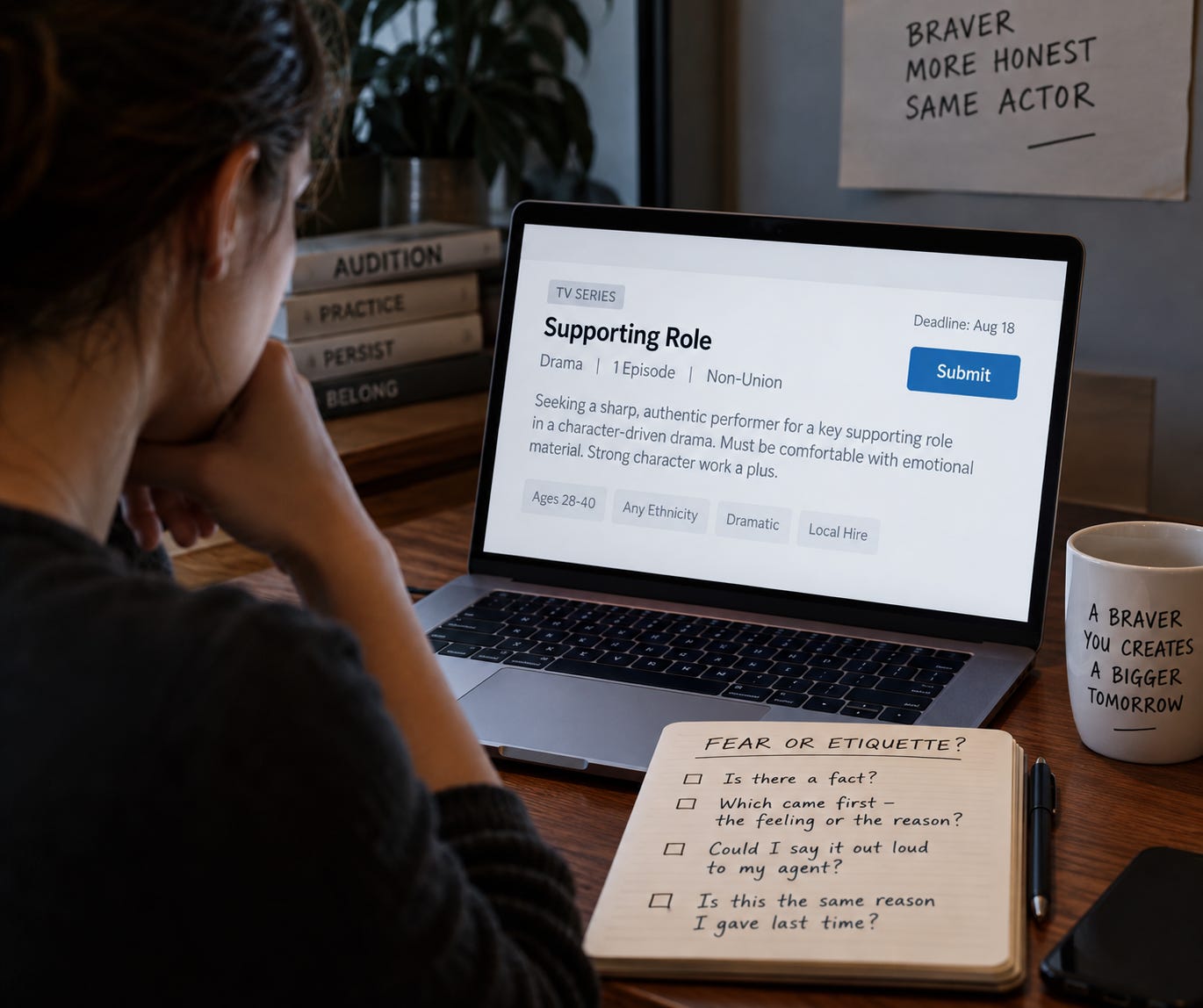
So here are four questions I want you to try the next time you’re about to close the tab.
The Fear or Etiquette Check
1. Is there an actual fact behind my decision?
Start here. Are you unavailable? Does the material cross a personal boundary? Would you turn down the job if it were offered? Are you intentionally taking time away? Is there a clear requirement of the role you just don’t meet?
Those are facts. You don’t have to overcome them, you don’t have to “push through,” and you certainly don’t need to prove how brave you are by ignoring your own boundaries. Knowing when to say no is part of being a professional.
But notice if you have to work hard to turn your reason into a fact. “They probably want...” “I don’t think they’d...” “Someone like me usually doesn’t...” Those aren’t facts. They’re predictions, and predictions get another question.
2. Which came first, the feeling or the explanation?
This one asks you to slow down. You read the breakdown, your stomach drops, you get that little flash of oh boy... and two seconds later you’re thinking, you know what, I’m probably not right for this anyway.
Interesting.
That doesn’t automatically make the reason false. But pay attention to the order. Sometimes the mind feels the fear first and builds the explanation second, and the explanation lets you escape the uncomfortable feeling while still feeling like a rational adult about it. That’s why self-sabotage is so hard to spot. It doesn’t feel like sabotage. It feels like good judgment.
3. Could I say this reason out loud to my agent or manager?
Not text it. Say it.
Picture your agent calling and asking, “Why don’t you want to go in on this one?”
“I’m booked those dates.” Easy.
“I’m not comfortable with the material.” Clear.
“I would never take this job.” Fair enough.
But listen to yourself when the answer turns into, “Well... I don’t know... I just think maybe they probably want somebody more... you know... established.”
There might be something underneath that. Don’t judge it, investigate it. Ask yourself, “What am I afraid might happen if I submit?” That’s usually a much more interesting question.
4. Does my reason keep changing?
This might be my favorite one.
Last month you needed better headshots, so you got better headshots. Then it was the reel, so you fixed the reel. Then you probably needed another class, so you took the class. And now casting wants someone with more credits.
At some point we have to notice that the finish line has grown legs and is walking away from you.
If the reason keeps changing every time you solve the last problem, the reason probably isn’t the problem. The problem is whatever all those reasons let you avoid. Being seen and judged. Being rejected. Or, and people don’t love hearing this one, succeeding and having your life change. That’s worth knowing.
So what do you do with the answers?
I don’t want these four questions turning into another rigid rule. The goal isn’t “fear means submit,” and it isn’t “doubt means ignore your instincts.” The goal is awareness.
If there’s a clear professional reason to pass, pass. No guilt, no second-guessing, no motivational speech required. Sometimes saying no is exactly what a professional should do.
But if you notice the explanation showed up right after the fear, or the reason keeps changing, or you’re predicting rejection before anyone has even had the chance to consider you, don’t close the tab yet. Sit there for one more minute and ask: “If I weren’t afraid of being rejected, would I still make the same decision?”
That question separates the career decision from the emotional protection, and that’s what I want actors to get better at. Not becoming fearless. Getting better at noticing when fear has been handed decision-making authority.
Your assignment this week
Think about the last role you decided not to submit for, and run the four questions on it. Was there a fact? Which came first, the feeling or the explanation? Could you comfortably explain it to your rep? Has this same reason, or some version of it, shown up before?
Don’t use the answers to beat yourself up. Use them to see more clearly. You probably won’t ever get rid of that drop in your stomach, and that’s fine. The goal is to stop letting it write the story about what you’re capable of.
So the next time you’re hovering over that submit button, don’t ask yourself whether you’re afraid. Ask: “Is fear giving me information, or is fear making the decision?” Tell me which one of these questions that caught you
.


